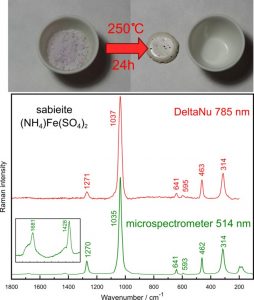
 New molecular data on exotic phases mineral occurring in fumarolic systems are reported in this paper. Fumaroles, vents that emit hot gases and vapor, are accompanying phenomena of volcanic activity. Such phenomena are also observed within the framework of self-ignited burning coal seams and coal heap. Rare anhydrous sulfates (millosevichite, mikasaite, efremovite, godovikovite, sabieite, and steklite) are signature minerals of such encrustations. Six synthetic anhydrous sulfates were prepared from the hydrated analogues, and were investigated using both a bench-top Raman microspectrometer and a portable Raman spectrometer. This comparative approach can help further steps for the successful deployments of miniature Raman tools in situ under field conditions. New measurements show that the performance of a light-weight portable Raman spectrometer with near infrared excitation was sufficient for the unambiguous discrimination of the investigated sulfates.
Košek F., Culka A., Jehlička J. (2018): Raman spectroscopic study of six synthetic anhydrous sulfates relevant to the mineralogy of fumaroles. Journal of Raman Spectroscopy 49, 1205-1216. (DOI)
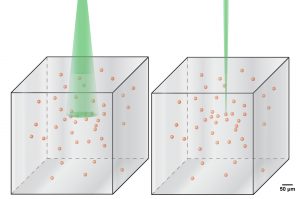 The miniature portable lightweight Raman spectrometer with 532 nm excitation enables unambiguous detection of carotenoids in microscopic inclusions in crystalline laboratory-grown salts – chlorides and sulfates. This is achieved without the use of any microscopic device. The results obtained can serve as a basis for proposing to use portable Raman spectrometers as a tool of first-pass when sampling salt and sulfate crystalline masses for carotenoid analyses in situ at outcrops or drill cores sampling. This report has relevance for search of biomarkers in exobiology context.
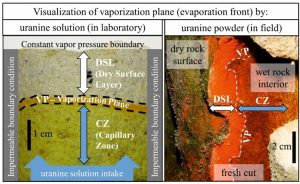 The vaporization plane in porous media separates the region of capillary flow from the dry surface layer, where the water transports in its gas phase. Knowledge of the depth and geometry of the vaporization plane is critical for estimating water flux in the soil-atmosphere interphase, for understanding evaporation processes in general, and for prediction of damaging salt crystallization locations. Use of sodium fluorescein (called also uranine) to visualize the vaporization plane in porous media in both laboratory and field experiments is presented. The property of uranine solution to change its color according to its concentration is used to: i) visualize the vaporization plane by forming a distinctive dark-orange zone where the pore water evaporates, and ii) to distinguish the zone of vapor flow from the zone where capillary flow is present. A complex-shaped vaporization plane in hydrophobic materials is also detectable. Uranine powder, when applied onto a porous material, clearly visualizes the dry surface layer and the capillary zone, divided by the vaporization plane.
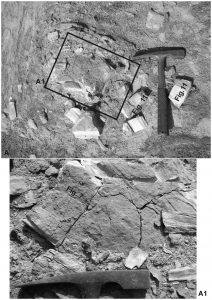 A new species of sessile barnacle Hexaminius venerai, described from the middle Eocene La Meseta Formation of Seymour Island, Antarctic Peninsula, is now the earliest known record of the genus in the Antarctic, its first occurrence from outside Australian waters, and the first record of a fossil cirripede attached to the substrate from the Antarctic. Exceptional preservation of more than 200 specimens revealed intriguing evolutionary aspects, suggesting that this species is a survivor of an early phase in balanid radiation, prior to the development of strong radially-interlocked parietes.
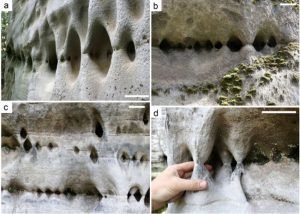 Critical evaluation of hundreds of photos of sandstone and other granular rock outcrops taken in various regions around the world revealed a presence of a specific sub-group of weathering forms related to planar discontinuities, hereby called arcades. The arcades are characterized as pits and cavities varying in size, but similar in shape, coalesced into „trains“ along the discontinuities, and separated from each other by hourglass-shaped pillars. In their origin and geometry, these forms differ from widely known cavernous weathering forms such as honeycombs and tafoni. Using numerical and physical in situ modelling, it has been shown that arcade shape and size are controlled by the redistribution of gravity-induced stress along planar discontinuities and the resulting stress shadow, which is characterized by material loss owing to various weathering and erosional mechanisms.
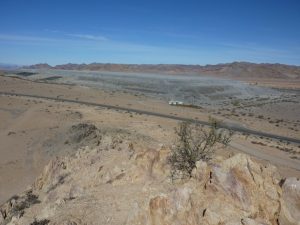 A combination of multiple techniques including XAS and isotopes helped to decipher the mobility of Tl in mining-polluted desert soil in Namibia. Mechanical transport of fine particles of post-flotation tailings is probably responsible for Tl dispersion in soil profiles.
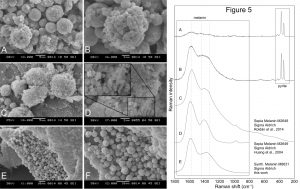 The oldest and until now the only fossil cuttlefish ink sac, possessing microbodies, has been recorded in the Middle Miocene (~13.5-Ma) deposits of the Vienna Basin. The geochemistry of these microbodies has been compared with the ink of the extant genus Sepia. The Raman spectra of melanin from the fossil cuttlefish ink, the S.officinalis melanin, and the synthetic melanin standards, showed identical curves. Therefore, the preservation of delicate cell organelles such as melanosomes has been proven in the fossil material. This investigation also indicates that the melanin (eumelanin) can be resistant to degradation in deep (geological) time.
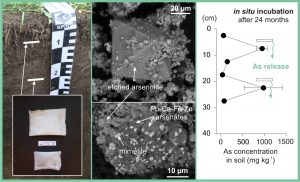 A first long-term (2 years) field experiment indicated how As and other metal(loid) contaminants can be released from As-rich copper smelter flue dust after deposition in contrasting soils. Up to 72% of As was leached out from the flue dust after incubation. The majority of As became highly mobile and could represent a risk for individual environmental compartments (soil, water).